



Court Marriage Procedure in Pakistan – Legal Requirements, Documents, and Registration Process
Court marriage procedure in Pakistan explained with legal requirements, Nikah documentation, witnesses, and Union Council marriage registration under Pakistani family law.
Court Marriage Procedure in Pakistan—Legal Requirements, Documents, and Registration Process
The court marriage procedure in Pakistan follows a clear legal framework based on Islamic marriage principles and family law regulations. A valid marriage is established through the free consent of the bride and groom, the presence of witnesses, preparation of the Nikah Nama, and registration with the Union Council.
Understanding the court marriage procedure helps couples ensure that their marriage is both religiously valid and legally recognized. Proper documentation and registration also protect the legal rights of both spouses and create an official record of the marriage.
In Pakistani legal practice, marriage is treated as a formal contract known as Nikah, which outlines the rights and responsibilities of both parties. The process of court marriage essentially involves documenting this contract and ensuring that the marriage is properly registered with the relevant authorities.
Legal Basis of Marriage in Pakistan
Marriage in Pakistan is governed by Islamic principles and the procedures established under family law regulations. The marriage contract is formalized through the Nikah Nama, which records the details of the marriage and the agreement between the bride and groom.
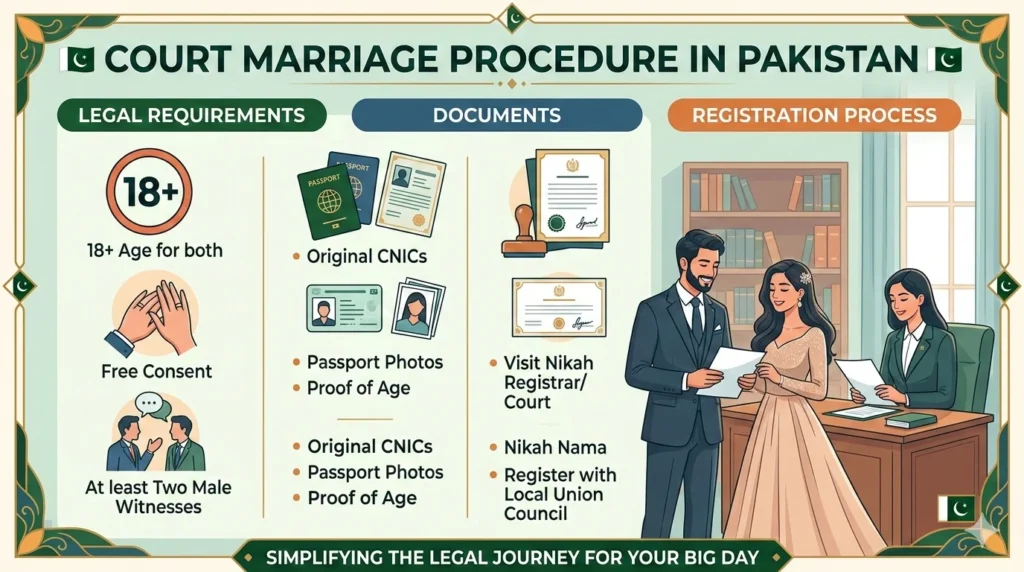
A marriage becomes legally valid when the following elements are present:
Legal Element | Explanation |
Consent of Parties | Both the bride and groom must willingly agree to the marriage |
Legal Age | The minimum legal marriage age is 18 years for both males and females |
Witnesses | Two adult witnesses must be present at the time of Nikah |
Nikah Nama | The marriage contract must be documented |
Registration | The marriage must be registered with the Union Council |
These elements ensure that the marriage is recognized under both Islamic law and Pakistani legal procedures.
Step-by-Step Court Marriage Procedure
The court marriage procedure generally follows a structured sequence beginning with identity verification and ending with official registration of the marriage.
Step | Procedure | Authority Involved |
Step 1 | Verification of the identity documents of the bride and groom | Lawyer / Nikah Registrar |
Step 2 | Preparation of Nikah documentation and consent statements | Legal Counsel |
Step 3 | Nikah ceremony conducted with witnesses | Licensed Nikah Khawan |
Step 4 | Signing of Nikah Nama by the bride, groom, and witnesses | Nikah Registrar |
Step 5 | Entry of marriage details in the Nikah register | Nikah Registrar |
Step 6 | Submission of marriage record to the Union Council | Nikah Registrar |
Step 7 | Issuance of Marriage Registration Certificate | Union Council |
This procedure ensures that the marriage is properly documented and recorded in official government records.
Documents Required for Court Marriage
Basic identity verification documents are required to complete the Nikah documentation and marriage registration process.
Person | Required Documents |
Bride | Original CNIC and passport-size photographs |
Groom | Original CNIC and passport-size photographs |
Witnesses | Two adult witnesses with CNIC |
Marriage Documentation | Nikah Nama preparation and signatures |
These documents allow the Nikah registrar to verify identities and ensure that the marriage contract is properly recorded.
The Role of the Nikah Registrar
The Nikah registrar plays a central role in the marriage process. The registrar is responsible for supervising the Nikah ceremony, ensuring that the Nikah Nama is properly completed, and maintaining the official Nikah register.
The registrar verifies the identity of the bride, groom, and witnesses before completing the marriage documentation. After the Nikah ceremony, the registrar forwards the marriage record to the Union Council for official registration.
This process ensures that the marriage becomes part of the official government record.
Importance of the Nikah Nama
The Nikah Nama serves as the official marriage contract in Pakistan. It records essential information regarding the marriage and establishes the legal terms agreed upon by the bride and groom.
Important details recorded in the Nikah Nama include:
- names of the bride and groom
• amount of mehr (dower)
• names and details of witnesses
• date and place of marriage
• conditions agreed between the parties
Because the Nikah Nama is a legal document, it serves as primary proof of marriage and may be used in legal proceedings if necessary.
Marriage Registration with the Union Council
After the Nikah ceremony is completed, the marriage record is submitted to the Union Council or Cantonment Board for official registration.
The Union Council maintains the official record of marriages within its jurisdiction. Once the registration process is completed, the Union Council issues the Marriage Registration Certificate, which confirms that the marriage has been recorded in government records.
This certificate is commonly required for:
- immigration applications
• inheritance matters
• family registration with NADRA
• legal verification of marital status
Legal Significance of Marriage Documentation
Proper marriage documentation provides legal protection for both spouses. The Nikah Nama records the contractual terms of the marriage, while the Marriage Registration Certificate confirms the official recognition of the union.
Maintaining accurate documentation helps ensure that the marriage can be verified whenever required for legal or administrative purposes.
Court Marriage Procedure in Major Cities of Pakistan
The legal procedure for marriage remains largely the same across Pakistan. Couples may complete marriage documentation and registration procedures in major cities such as:
- Karachi
• Lahore
• Islamabad
• Rawalpindi
Because the legal framework governing marriage is consistent throughout the country, the documentation and registration process follows similar procedures regardless of the location.
Frequently Asked Questions About Court Marriage Procedure
What is court marriage in Pakistan?
Court marriage generally refers to a Nikah conducted with the free consent of two adults and properly documented through the Nikah Nama, followed by registration of the marriage with the Union Council.
What is the legal age for marriage in Pakistan?
The minimum legal marriage age in Pakistan is 18 years for both males and females, and identity documents such as CNIC or passport are used to verify age before the Nikah ceremony.
How many witnesses are required for marriage?
Two adult witnesses must be present during the Nikah ceremony. Their names and signatures are recorded in the Nikah Nama to confirm the validity of the marriage contract.
Is marriage registration mandatory?
Marriage registration with the Union Council is necessary to ensure that the marriage is officially recorded in government records.
What is the difference between a Nikah Nama and a marriage certificate?
The Nikah Nama is the marriage contract signed during the Nikah ceremony, while the Marriage Registration Certificate is issued by the Union Council after the marriage is registered.
Who performs the Nikah ceremony?
The Nikah ceremony is conducted by a licensed Nikah Khawan or Nikah Registrar, who supervises the marriage contract and documentation.
Can two adults marry without family permission?
Under Pakistani law, two adults who meet the legal age requirement may marry with their free consent. Family approval is culturally valued but not a legal requirement.
How long does the marriage documentation process take?
The Nikah ceremony and documentation may be completed within a few hours once the required documents and witnesses are available. Marriage registration with the Union Council follows the submission of the Nikah record.